Programming and Fiber Arts
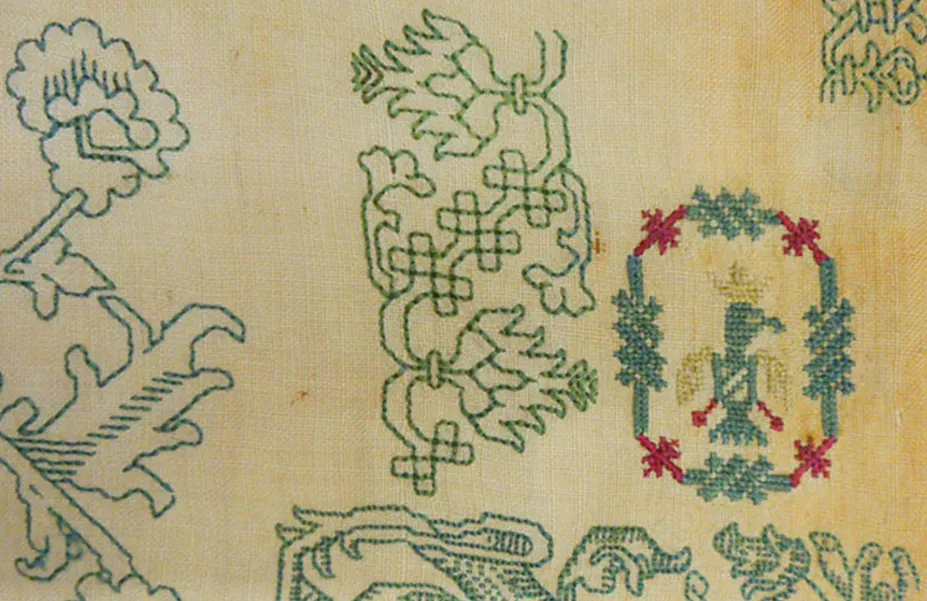
(A portion of a needlepoint sampler from 16th century Italy)
It's no secret I love vintage/retro computing. I have a lot of nostalgia for pre-Internet devices (I'm sure I'll explore that more in a future post), from PCs to consoles, there's plenty to learn about. And what's cool is that there always seems to be an earlier breakthrough to research.
This weekend I spent time looking into pre-computer computing and specifically how the fiber arts laid I very strong foundation for computing as we understand it today.
The Jacquard Loom used punch cards to automate the weaving process, and those punch cards inspired Baggage and Lovelace. What are holes in a punch card if not a type of binary code? These cards would physically block or allow hooks to pass through them, determining which threads were raised or lowered. By using a series of cards, even untrained weavers could create incredible patterns. This technique was so revolutionary that it lasted well into the 20th century, with cards being printed through the 1980s. Now it seems, somewhat ironically, that digital computers have taken over.
And speaking of binary, in the 1950s and 1960s non-volatile computer memory (never erased, even if power is lost) was physically woven so that it could survive, harsh environment, even in space. This core rope memory would send a wire through a small magnetic ring to represent a 1 and around it to represent a 0. When Margaret Hamilton wrote the Apollo code, it was sent to a factory where women (and it was almost all women) would spend months physically weaving the wires to create a physical representation of the program. This representation was used by the Apollo guidance computer to help navigate to the moon and then return home.
And Susan Kare, the 10th employee at Apple, used her background in needlepoint as the basis of early computer icons. Simply conveying text and images has been used in needlepoint for centuries. Samplers have been used for family recordkeeping, religious celebrations, and as exemplars of personal skill, and each stich can be seen as a pixel (hopefully seen in the picture at the start of this post). Kare took this same concept onto the computer screen and created the first iteration of our modern interfaces.
It's been fascinating learning how logic was used to create beautiful and functional pieces of art, through techniques like weaving and needlepoint, centuries before computers were even dreamed of. And now we can see that same logic being used in computers today.