CGA is great!
CGA is great. I've been a fan for a long time. Possibly because the card is about as old as I am (it came out in 1981), or possibly because my family didn't upgrade computers frequently so I spent a lot of time with those games. Either way, a large part of my childhood was spent in front of the IBM 5150 with its CGA graphics (which we got used because the adjusted for inflation price puts that systems at nearly $6,000US in today's dollars).
I also hang out with older people and retro computing enthusiasts and so I find myself having conversations about CGA graphics more than the average person. This morning someone said there should be a blog post about how CGA is great, so I figured I'd give it a shot!
Before I started writing I hopped online to see what others felt about CGA graphics, specifically early 4-color CGA games from 1981-1983. I was surprised at the results. They're almost universally hated. It caught me a bit off guard because I remember the era so fondly, so I decided to write out my reasons why. First though, is some background on CGA.
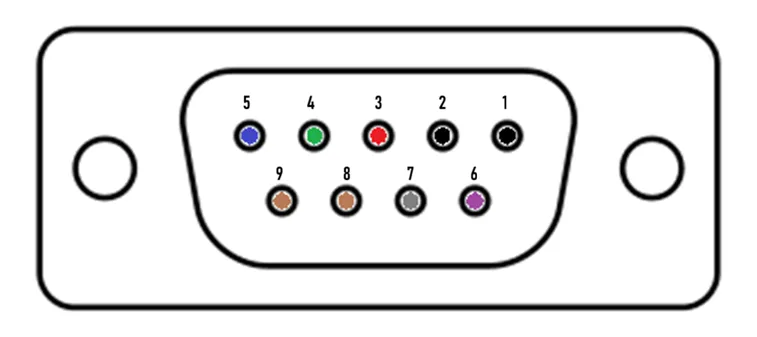 [1&2-Ground, 3,4,&5-RGB, 6-Intensity, 7-Monochrome, 8&9-H and V Sync]
In the image above, you can see the RGBI 9-pin connector. The blue, green, and red dots represent the colors that were sent to the monitor. Each wire could either be on or off so the only way to get different colors was change which wires were sending information. Because there are three colors (3 wires) and each can be on or off (2 states), we know that there are only eight possible colors that can be sent (2x2x2).
However, the purple dot is the "intensity" wire and it would add one level of brightness to the colors above, meaning that CGA could produce 16 colors total. See below for a great graphic of the possible colors in CGA and follow the citation link for some more information about how exactly those colors are made.
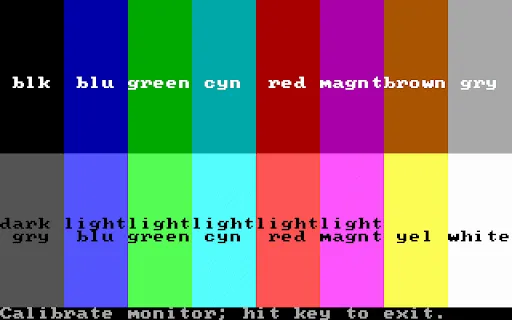
From http://www.oldskool.org/pc/cgacal
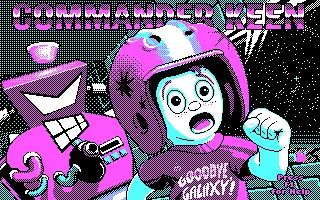
This 16 color limit is a bit misleading. CGA cards shipped with a whopping 16 kilobytes of memory and because of this there were a few different graphics modes, the primary split being between text only or graphics. Text only mode could support all 16 colors on the screen at once and so games like Lawn Mower looked bright and vibrant. But when the system used one of the graphical modes, sacrifices had to be made. The most common mode I remember was the 320x200 resolution mode that could only support 3 different palettes made up of 4 different colors (with high and low intensity variants). That means that CGA games that used Palette 1 (black, cyan, magenta, and white) looked like this:
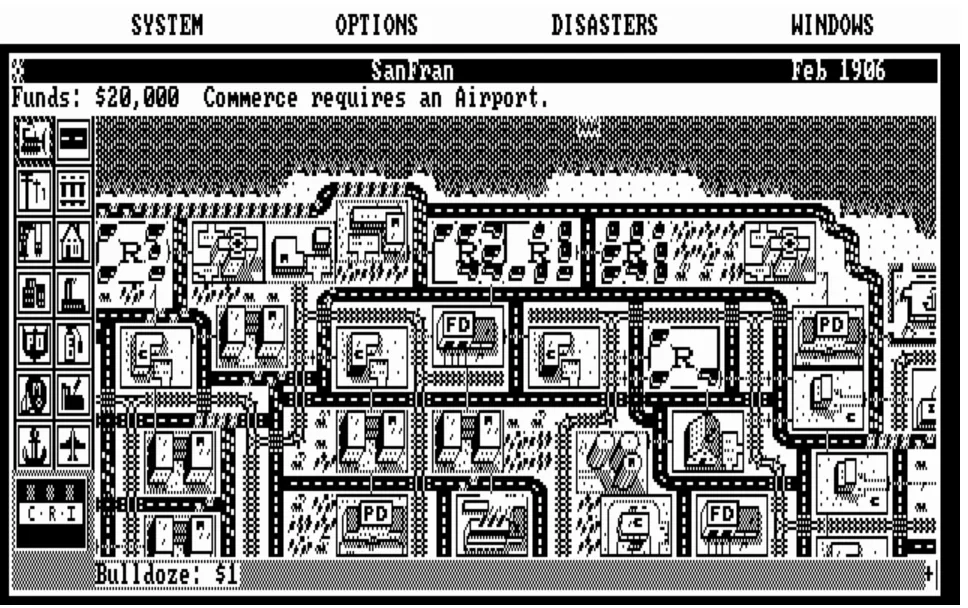 Simcity had a 640x200 resolution, but that limited it to only two colors.
So there's an overly simplified explanation about CGA, but why is it great? I think this is where nostalgia comes in. I think it's important to understand the the IBM 5150 was designed with work in mind, not gaming. There's a reason all 16 colors originally only worked in text mode but not in any graphics mode. The color palettes seem to be high contrast enough that readability was the first concern, not graphics for games. However, we can't discount the popularity of gaming, so it's not surprising that the system would be used for that as soon as it came out.
1981 was one of the best years in early arcade gaming, with Donkey Kong, Defender, and Pac-Man being released. When it came to home consoles, people really only had access to Pong clones, the Atari VCS, and Intellivision. All of those were solid systems with serviceable graphics, especially for the era, but they cost money. But what if your dad bought a computer to do spreadsheets on? And what if that system had a CGA card in it? And what if you could play rudimentary games on it?
CGA graphics represent a fairly short period in PC gaming (EGA came out in 1984), but it was an important one. I think it represents a momentous shift in computers, where they started to transition from being work machines that can play games into gaming machines that can also do work. Because early CGA computers weren't designed with gaming in mind, there were pretty harsh limitations that designers had to work around. As memory prices came down and gaming became more popular, it's not surprising that CGA grew as well. The fact that EGA was backwards compatible with CGA also helped.
It's pretty clear IBM saw this trend when it released the IBM PCjr in 1984 with expanded graphical memory. Now CGA games could be played with 16 colors at 320x200, and at 640x200 games could use a 4 color palette. Goodbye monochrome Simcity.
True 4-color CGA was a very short period of time in this history of video games, and EGA and VGA which came after look significantly better, but I think there's a charm to this old system. Driving a Model T, which was miserable to start, miserable to shift, and miserable to operate, is still a fun experience in its own way.
Besides, there are still amazing CGA games coming out now. Every year there's a CGA Jam with dozens of entries you can play now, including 20+ that run in your browser. Paku Paku is also a great Pac-Man clone that utilizes the CGA text-only mode to take advantage of all 16 colors on the screen at once, which makes it look incredible. The best version of Alley Cat is the CGA version (playable in browser), and Tapper is also great (also playable in browser.)
So CGA, especially 4-color CGA, wasn't around a long time, but there were thousands of incredible games made for it over the past 45 years, and more are still coming out. It would be a shame to overlook them because, as I mentioned earlier, CGA is great.